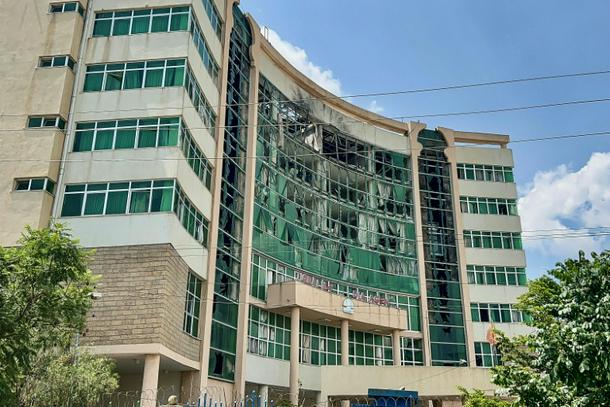
The buidling of the Tigray TV broadcaster was hit by a drone strike on Sunday as violence flared
Addis Ababa (AFP) - Ethiopian federal forces had entered the Tigray state capital on Saturday, a humanitarian source told AFP, after residents reported that the region’s rebels had abandoned the city.
Fighting erupted on September 23 in northern Ethiopia as the rebel Tigray People’s Liberation Front (TPLF) launched attacks into neighbouring states, raising fears of a return to the devastating 2020-2022 civil war.
But federal forces and pro-government militias have pushed them back in recent days and were heading north towards the regional capital, Mekelle.
“Ethiopian federal forces and allied forces have reportedly been observed in Mekelle city… across various locations,” a humanitarian source said told AFP late Saturday, citing reports from staff on the ground.
Earlier, a journalist in the city told AFP that “TPLF militants and leaders are leaving Mekelle”.
He said government offices and police stations had been left without security personnel.
The journalist could not be reached for more details, as telecommunications networks have been severely disrupted in Tigray since hostilities, making the few bits of information that emerge difficult to verify.
- Regional summit -
“I am concerned that government and public property could be exposed to looting because there are no security forces in the city,” a local resident told AFP.
“Lawlessness could spread in the city, and I am also afraid for my life. I want us to quickly return to law and order,” added another resident.
Neither the spokesperson for the Ethiopian National Defense Forces nor that of federal Prime Minister Abiy Ahmed has responded to AFP’s requests for comment.
A diplomatic source told AFP that a mini-summit on Sunday would bring together the presidents of Egypt, Eritrea and Somalia, Hassan Sheikh Mohamud, as well as the head of the Sudanese Armed Forces (SAF), Abdel Fattah al-Burhane, in Alamein, Egypt, on the sidelines of an African Business Forum.
The TPLF has long been the dominant force in Tigray, ousting a government-appointed administration earlier this year.
In a video message on Thursday, its leader Debretsion Gebremichael implied the TPLF would continue guerrilla-style attacks as they did when Mekelle fell to government forces in 2020.
Their insurgent campaign ultimately led to the TPLF retaking the city in mid-2021.
“We operate under a strategy to strike the enemy wherever we choose,” Debretsion said.
- Regional tensions -
The conflict has triggered a breakdown in Ethiopia’s relations with Eritrea and Egypt, which Ethiopia accuses of supporting the rebels.
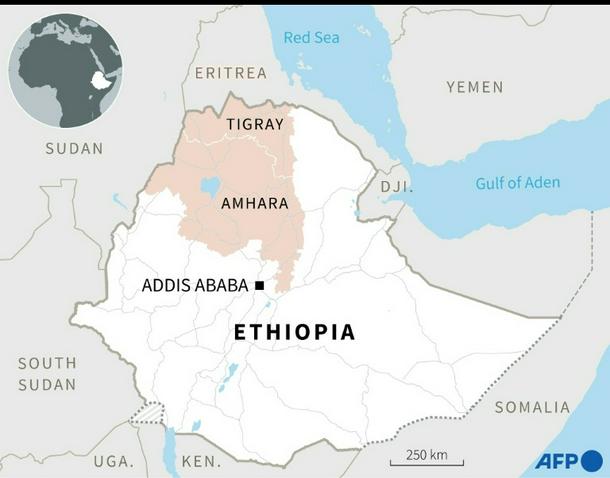
Map of Ethiopia locating the Tigray and Amhara regions.
Ethiopia expelled 10 Eritrean diplomats and shut its embassy in Asmara on Thursday, while Eritrea responded that it would “sever all diplomatic ties”.
Eritrea accuses landlocked Ethiopia of planning to invade and seize access to its coastline.
The TPLF’s Debretsion said in his video message that “the war is regional and it is a war to control the Red Sea”.
Ethiopia also expelled an Egyptian diplomat without explanation, prompting a reciprocal move by Cairo.
- Counter-offensive -
The rebels initially made advances in neighbouring Afar and Amhara states, working alongside local militias.
But they were pushed back this week, and the government launched a counter-offensive into Tigrayan territory along three axes towards Mekelle, according to the Critical Threats Project, part of the American Enterprise Institute think tank.
There were reports that Mekelle’s airport, on the southern approach to the city, had fallen to a pro-government militia on Friday.
But social media accounts are difficult to verify, media access is heavily restricted and there have been significant communications blackouts.

A tuk-tuk makes its way through Mekelle amid reports the airport had fallen to a pro-government militia
Earlier, a humanitarian source told AFP on condition of anonymity that the TPLF had been entirely pushed out of Afar.
The TPLF ruled all of Ethiopia from 1991 to 2018, when it was marginalised with the rise of Prime Minister Abiy Ahmed, who hails from the Oromia region.
The tensions led to a civil war from 2020 to 2022 – one of the deadliest in the world in recent times – that left more than 600,000 dead, according to the African Union.
The Pretoria peace agreement of 2022, brokered by African institutions and Washington, maintained an uneasy calm until last year, but was never fully implemented.