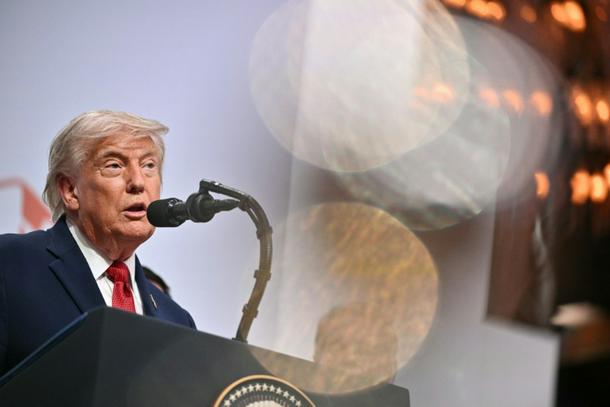
US President Donald Trump's administration said it would impose a new 25 percent on Brazil
Washington (United States) (AFP) - An incoming US tariff targeting various imports from Brazil has drawn a sharp rebuke from the Latin American giant, as Washington accused the country of unfair trade practices and policies.
The levy, announced Wednesday, is set to take effect July 22 and is shaping up as a major campaign flashpoint three months before Brazil holds a presidential election.
Washington imposed the tariff after a year-long investigation into Brazilian policies it argues harm US commerce – an accusation Brasilia has fiercely denied.
A range of products, including beef, coffee and certain aircraft parts, will be exempted, however, a senior US official told reporters. The exclusions also cover some goods not produced by the United States.
US Trade Representative Jamieson Greer’s office said Brazil’s “unreasonable” policies have hurt US commerce by unfairly benefiting Brazilian producers and “restricting access to one of the world’s top export markets.”
Brazil condemned the tariffs Thursday, vowing “reciprocal” measures as both sides traded barbs.
- Not in ‘good faith’ -
“There is no justification for unilateral measures against our country,” President Luiz Inacio Lula da Silva’s office said in a statement on X.
Deploring the “lamentable outcome,” he highlighted that in 2025, 76 percent of imports originating from the United States entered his country without paying import duties.
US Secretary of State Marco Rubio added that the Brazilian government had “not negotiated with the US in good faith.”
“Lula has put his own ego ahead of making a deal for the welfare of the Brazilian people, and these tariffs are the price for that,” he said on X.
But Brazilian Foreign Minister Mauro Vieira slammed Rubio’s remarks as “crude and arrogant.”
While the US National Coffee Association lauded the tariff exemption for coffee, a group representing American small businesses warned that they will bear the brunt of higher import costs.
“Businesses buying everyday products from Brazil will now pay new tariffs because of disputes over digital payment rules and other policies they have nothing to do with,” said Dan Anthony, executive director of the coalition named We Pay the Tariffs.
- Political friction -
The tariff issue has increased political friction ahead of Brazil’s October election as well.
Lula’s main rival is Flavio Bolsonaro, son of far-right former leader Jair Bolsonaro, who is serving a 27-year sentence for attempting a coup d’etat.
Trump imposed tariffs on Brazil last year over the trial of his ally, although many of those duties were lifted after talks between the countries and as US households grappled with rising costs.
While Jair Bolsonaro’s sons backed those tariffs during their father’s trial, Flavio Bolsonaro urged Washington against the new duties, arguing they could boost Lula’s electoral campaign.
“Lula is no longer fit to be the president of Brazil,” the younger Bolsonaro said after the fresh duties were announced.
The 44-year-old senator has fallen in polls after a financial scandal and a public feud with his stepmother.
The new tariff comes as Trump’s administration pushes to rebuild his economic agenda after the US Supreme Court in February struck down a swath of his global duties.
The Brazil tariffs were justified under Section 301 of the Trade Act, which the Trump administration also used this year to initiate other trade probes.
US officials have already proposed new tariffs targeting dozens of trading partners for their alleged failure to act against forced labor.
In Brazil’s case, Washington argues that illegal deforestation in the country makes it hard for the US logging industry to compete in global markets, among other issues.
Brazilian data shows deforestation in the Amazon fell last year to its lowest point since 2019.
The United States also charged that Brazil’s free PIX electronic payment system – the dominant method of making payments in the country – disadvantages US credit card companies.
Greer said the United States remained open to negotiations. But a US official warned that pushback could invite further US countermeasures.